

A musty smell in house environments signals biological activity, not simple staleness. Certain compounds produced
Musty odors in a house trace to microbial volatile organic compounds, or mVOCs, released by active mold colonies one of the clearest answers to what causes musty odor in the first place, especially when hidden indoor mold is the source. These gases carry the earthy, stale quality residents notice even without visible growth. US Enzyme's enzyme-based cleaners work as an effective enzyme mold odor remover, breaking down mold and mycotoxins at the source and addressing the odor rather than masking it with fragrance.
Key Takeaways
- Mold produces microbial volatile organic compounds (mVOCs) that create musty, unpleasant odors in homes.
- Mycotoxins are toxic byproducts of mold that cause neurological health issues requiring proper management.
- Musty smells persist even without visible mold growth, indicating hidden moisture and contamination problems.
- Plant-based enzyme formulations with essential oils support wellness by addressing mold-related toxin concerns naturally.
What Does a Musty Smell in a House Mean?
A musty smell in house signals biological activity, not simple staleness. Certain compounds produced by mold are volatile, releasing quickly into the air and carrying odors strong enough to notice from across a room. That chemistry answers the question of why does my house smell musty: the source is often airborne, not visible.
These airborne compounds have a name. What are MVOCs, exactly? They stand for microbial volatile organic compounds, gases produced by microorganisms mold, bacteria, and other biological material as they grow and metabolize. Because these compounds often carry strong or unpleasant odors, they frequently account for the mold smell in house conditions that residents and property managers report before any staining or growth becomes visible.
Does a Musty Odor Always Mean Mold Is Present?
A moldy odor suggests mold is growing somewhere in the building and warrants investigation. The smell itself is not proof of a specific location or extent of growth. It is a reliable signal that something biological is active. Property managers and homeowners should treat the odor as a starting point for inspection, not a condition to mask.
Where Do These Odors Typically Concentrate?
Musty odors often settle in enclosed, low-airflow spaces where moisture lingers longest.
- Basements and crawlspaces, where a persistent musty basement smell frequently points to trapped humidity
- Closets and cabinets built against exterior walls
- HVAC ductwork and air handlers
Understanding how to get rid of musty smell conditions starts with locating the source rather than covering the odor. For homeowners, renters, and property managers facing persistent odors, enzyme-based cleaning formulations offer a science-backed option, addressing the underlying biological growth rather than temporarily masking its byproducts. US Enzyme ships enzyme-driven mold and mycotoxin cleaners to households nationwide for exactly this diagnostic-first approach.

A musty smell in house rooms does not always match visible mold growth. Both conditions
Why Does My House Smell Musty With No Mold?
A musty smell in house does not always match visible mold growth. Both conditions look connected, but they trace back to different underlying mechanisms, and one can exist entirely without the other.
Odor and appearance operate on separate tracks. A property can carry a persistent musty scent with zero visible spots on walls, baseboards, or ceilings. The reverse also happens: mold colonies grow in a space while the air stays relatively odor-free. Recognizing which situation applies is the first real step toward solving it, rather than chasing surface stains that have nothing to do with the smell.
What Are MVOCs, and Why Do They Smell Like Mold?
The odor most homeowners associate with mold actually comes from a specific chemical source. What are MVOCs? They are microbial volatile organic compounds gases released as mold organisms grow, digest material, and reproduce. These compounds carry the earthy, damp, "basement" quality people recognize instantly, even when no colony is visible in the room producing the smell.
Does a Musty Basement Smell Always Mean Poor Air Quality?
A lingering musty basement smell often signals compromised indoor air quality well before any mold becomes visible. That distinction matters for property managers and renters alike:
- Odor without growth: MVOCs escaping from a hidden or dormant colony, without staining the surface nearby.
- Growth without odor: Active colonies producing minimal volatile compounds at that stage.
- Both present: Advanced colonization, often signaling a longer-standing moisture problem.
A mold smell in house air, in any of these scenarios, points to conditions worth investigating rather than masking it. Understanding the pattern determines the right remediation approach.
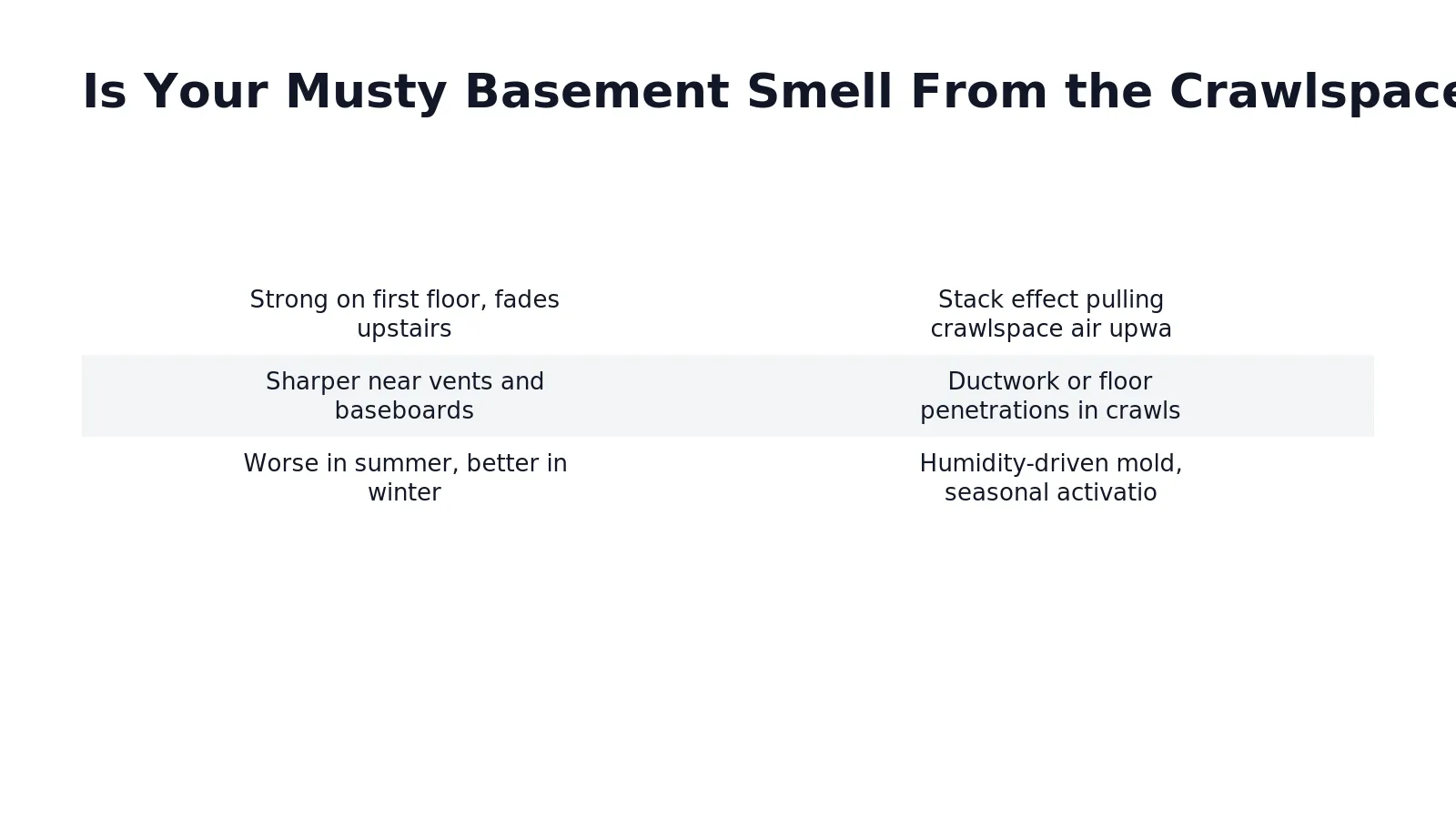
Is a Musty Basement Smell From the Crawlspace?
Location pattern separates a crawlspace odor from every other source in the home. Where the smell shows up, and when it strengthens, tells the real story faster than a visual inspection alone.
A musty basement smell that dominates the first floor and thins out upstairs points toward the crawlspace below. Warm air rises through the structure in what is known as the stack effect, pulling crawlspace air and the compounds riding along with it up into the lowest living level. A concentrated odor at the crawlspace access door confirms the pattern.
Why does the smell get stronger near floor vents?
Odor that sharpens near floor registers and baseboards signals crawlspace air moving through ductwork or gaps in the floor structure. Leaky ducts routed through the crawlspace pick up moisture and odor, then distribute both through the HVAC system. Checking ductwork in the crawlspace for leaks and condensation narrows the diagnosis considerably.
Does the smell change with the seasons?
Seasonal shifts matter. A smell that intensifies in summer and fades in winter reflects humidity-driven mold activity in the crawlspace rather than a fixed, year-round source. Measuring crawlspace humidity with a hygrometer confirms whether seasonal moisture swings are driving the growth cycle.
| Pattern Observed | Likely Cause |
|---|---|
| Strong on first floor, fades upstairs | Stack effect pulling crawlspace air upward |
| Sharper near vents and baseboards | Ductwork or floor penetrations in crawlspace |
| Worse in summer, better in winter | Humidity-driven mold, seasonal activation |
These patterns build a practical checklist for narrowing the source before choosing a cleanup approach.

That gap in research matters for anyone trying to interpret a mold smell in house
What Health Symptoms Link to Mold VOCs?
Microbial volatile organic compounds, or mVOCs, carry a documented but incomplete list of physical symptoms. Exposure has been linked to headaches, nasal irritation, dizziness, fatigue, and nausea, though the full scope of health effects remains largely unknown. Researchers still lack enough data to confirm whether non-occupational indoor exposure to mVOCs produces additional effects beyond this initial list.
That gap in research matters for anyone trying to interpret a mold smell in house environments. A musty odor is not proof of a specific illness. It is a reliable signal that biological growth is producing volatile compounds worth investigating.
What are MVOCs, exactly?
MVOCs are gases released as mold metabolizes the material it grows on. They carry the earthy, musty scent most people associate with hidden mold, even when no visible growth is present. Because these compounds are airborne, they reach occupants throughout the property, not just near the growth site itself.
Mycotoxins present a separate and more serious concern. Unlike the odor-causing mVOCs, mycotoxins are toxic byproducts of mold linked to neurological health issues, and they require dedicated remediation rather than odor control alone.
Symptoms commonly associated with mVOC exposure include:
- Headaches
- Nasal irritation
- Dizziness
- Fatigue
- Nausea
Addressing a lingering odor, then, involves more than freshening the air. It means reducing potential exposure to mold and allergens tied to the underlying growth. US Enzyme's enzyme-based formulas target both the surface mold responsible for the smell and the mycotoxins that ordinary cleaning misses, supporting a more complete response for households, rental units, and managed properties dealing with persistent musty conditions.
How Can Musty Smell Be Removed?
Getting rid of musty odor starts with fast drying and enzyme-based treatment, not air fresheners. Water-damaged materials left wet for more than 24 to 48 hours allow mold colonies to establish themselves. Once that happens, the odor typically returns no matter how often a space gets aired out. Property managers and homeowners who catch moisture early after a leak, a flood, or even a humid crawlspace cut off the problem before it produces the volatile compounds responsible for that stale, earthy smell.
Speed matters more than most people assume. A damp carpet, a soaked drywall panel, or a wet subfloor left untouched for two days becomes a viable mold habitat. Drying equipment, dehumidifiers, and fans reduce that window and protect the structure from taking on a permanent odor source.
Why Does the Smell Not Go Away After Cleaning?
Surface cleaning and masking sprays only cover odor temporarily because they leave mold and its byproducts intact underneath. An enzyme-based mold cleaner breaks down existing mold growth and its mycotoxins at the source, producing a longer-lasting fix rather than a temporary cover-up. US Enzyme formulates its cleaning products with plant-based enzymes and essential oils, avoiding the harsh chemical approach many traditional cleaners rely on.
How can homes prevent the smell from coming back?
Cleaning alone does not guarantee mold stays away. Applying a preventive antimicrobial barrier product after remediation helps stop regrowth on surfaces that have already been treated. The same approach works for pre-treating building materials before walls or subfloors get closed in, giving households a longer window of protection.
Recommended approach for lasting odor removal:
- Dry all water-damaged materials within 24–48 hours.
- Treat visible and hidden mold with an enzyme-based formula.
- Apply a preventive barrier product to treated surfaces.
- Recheck high-humidity areas periodically for recurring dampness.
FAQ
What are mVOCs?
Microbial volatile organic compounds are gases produced by mold, bacteria, and other biological material as they grow and metabolize, often carrying strong, unpleasant odors that create the musty smell in homes.
Why do mycotoxins matter for indoor air quality?
Mycotoxins are toxic byproducts of mold that cause neurological health issues, making proper management essential wherever mold produces musty odors in a home.
How do enzyme-based cleaners address musty odors?
US Enzyme's enzyme-based cleaners break down mold and mycotoxins at the source, addressing the underlying biological growth that causes odor instead of masking it with fragrance.
Conclusion
Musty odors stem from mold-produced volatile organic compounds, so effective remediation must address both visible growth and the mycotoxins it generates. A targeted approach neutralizes these toxic byproducts at their source rather than masking the smell. Enzyme-based cleaning that targets mycotoxin degradation gives homeowners and professionals a path to healthier indoor air, grounded in true remediation rather than temporary relief.


